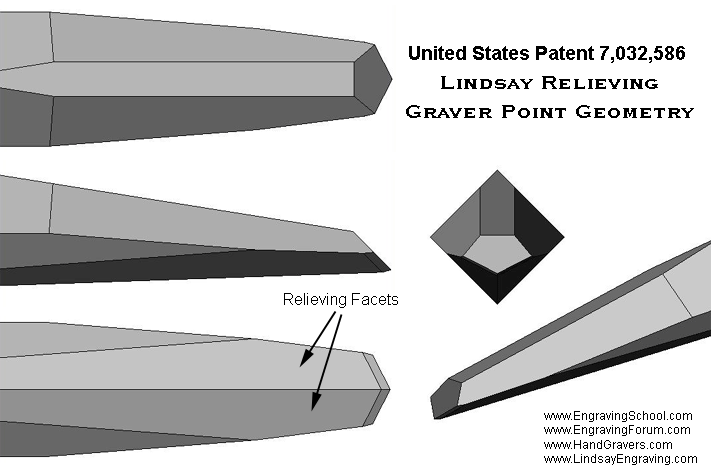
Note: Traditional 110, 120 and
130 degree gravers do exist. They are described in the prior art
section of the patent, however the patented point with the relieving
cutting edge is different and will cut with less drag. The point can
be utilized on narrow points under 90 degrees as well as the wider points.
Learn to grind narrow and wide width points on the next page.
One pre-sharpened Carbalt graver with this point is included with each customer's first purchase of
an AirGraver handpiece.
Benefits of the Point Geometry
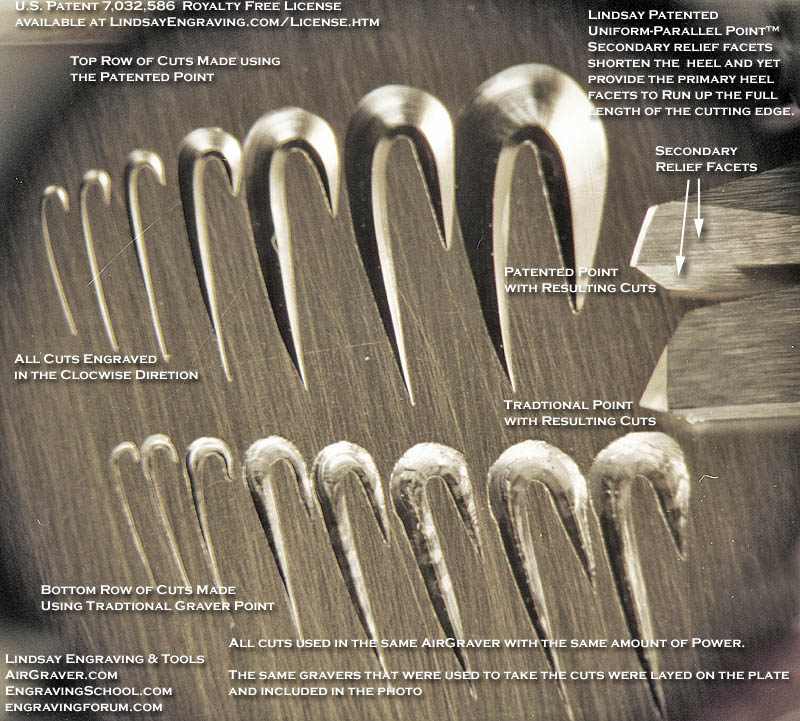
The five photographs below help illustrate the problem of heel drag with the traditional graver points, and show how the
patented point eliminates it. The five photographs were taken through a microscope, and are a series of cuts made on a steel plate.
Click photos for more detail

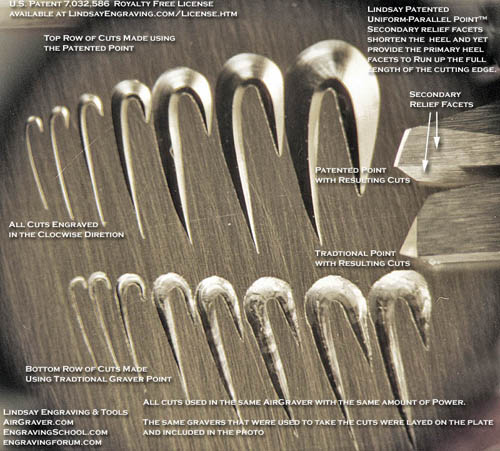
The first photo shows a
complete shot of the plate. The two gravers that were used to make the
cuts are lying on the plate, and are rotated so that the heels of the
gravers can be seen.
The upper row of cuts was
made using the patented relieving point, and the lower row of cuts were
made with the traditional graver point. One of the points was installed in
an AirGraver handpiece and a row of cuts was made with it. Then the other
point was installed and the second row of cuts was made. The same power
level (PSI level and piston stroke length) and hand motion were used to
make the cuts for each point. Both points were made from Carbalt graver
stock.
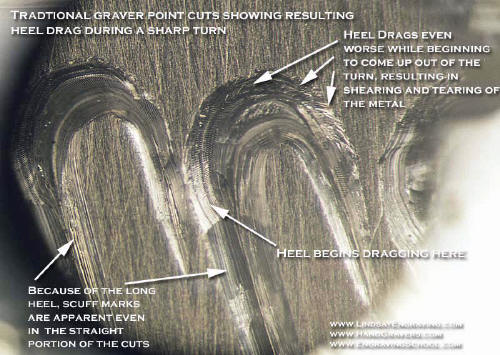
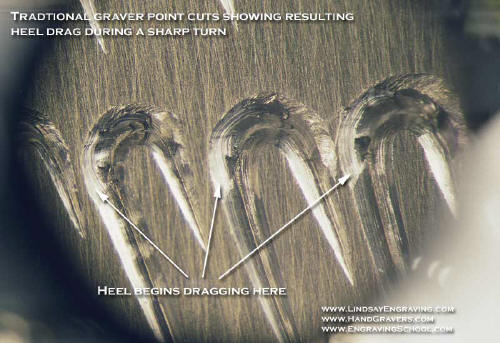
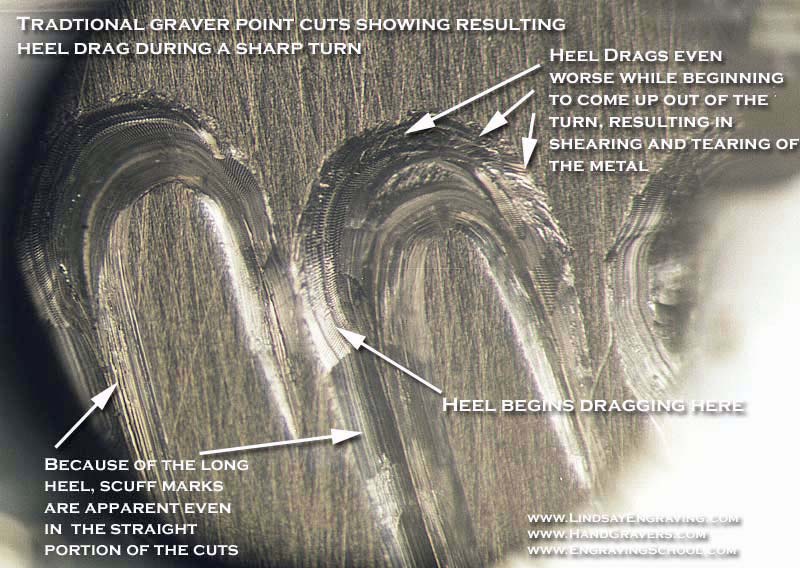
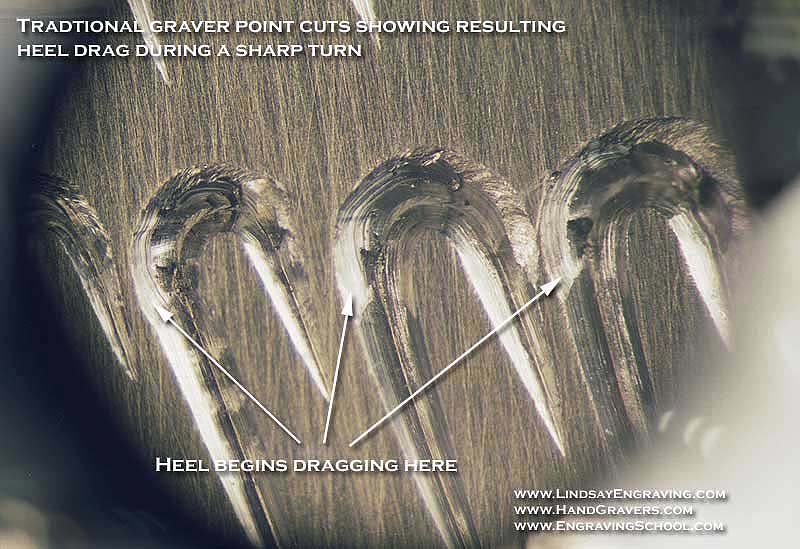
The two photographs below
are close-ups of the traditional graver point cuts. Note the heel drag
that is evident in the cut as the graver came around the corner. With the
traditional point there is no clearance for the heel in the V furrow as it
comes around the turn, and it drags on the outside of the arcs within the
V furrow. Arrows in the photographs show where the heel first begins
dragging. It can be seen that, as the traditional point continues around
the corner, the heel hits with more interference and begins tearing the
metal. Click
photos for more detail


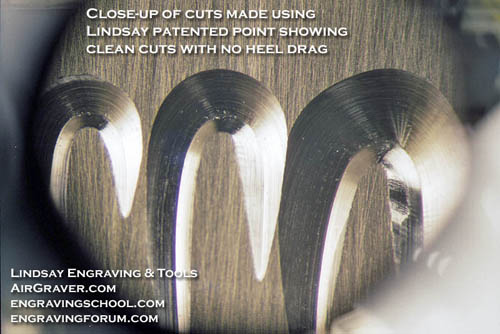
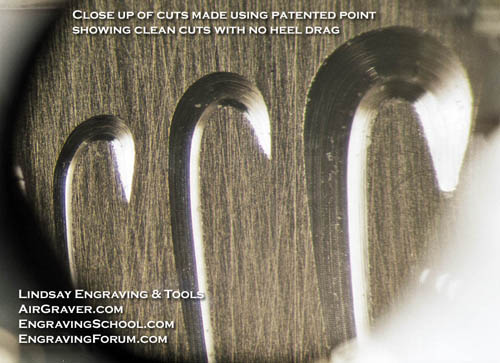
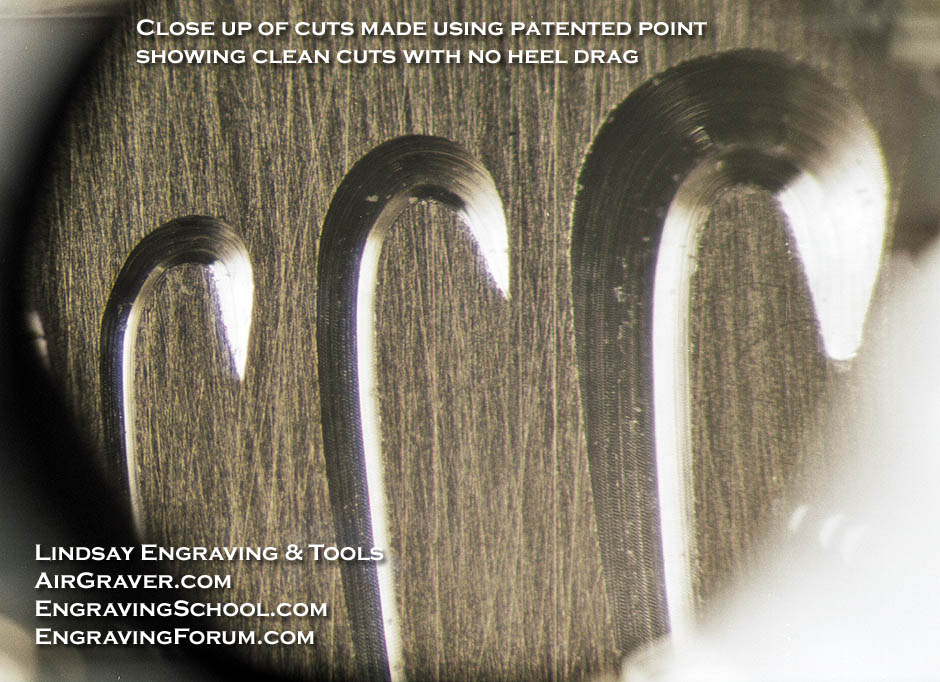
The two close-up
photographs below show how the patented graver point cuts. Note how much
cleaner these cuts are since the heel is not dragging through the cut. The
heel drag is eliminated. The patented geometry works just as well for the
fine cuts as it does heavier cuts, without having to alter the size of the
primary heel. Click
photos for more detail


Additional benefits
The heel relieving graver can go deeper into the metal than a traditional
graver point using the same power level. The heel on the traditional
graver point is actually giving more resistance as it is driven through
the metal. This is especially evident around corners like those shown in
the sample plate. While making a cut, the traditional graver tends to come
up out of the metal, and it is therefore necessary to push straight down
on the point itself to hold and keep it in the cut around the corner.
This is why various books
and instructions advise engravers to hold their index finger on top of the
point and push down to keep it in the cut when using a power assisted
tool. This is necessary with the traditional graver, or it would be out of
the cut and sliding across the work. The downward pressure, however, also
contributes to casting a bur on the edge of the cut. The downwards push is
trying to force the tip to do something it refuses to do. This will help
raise burs, and may require sanding the surface of the engraving when
finished. After engraving, the surface should not need to be sanded or
re-polished. If sanding is necessary, there is something wrong with the
graver point.
Sanding takes away the
grays that were achieved while shading, and will lighten the overall
engraving. It will also leave white streaks in the grays of the shading.
The uniform parallel geometry
has a shorter heel because of the secondary relief facets, and allows the
cutting edge to go through the metal cleanly and without drag. The point
is therefore more efficient in cutting, and it takes less power than a
traditional point to execute a cut of the same depth. The cuts in the
sample plate illustrate this by the dramatic increased depth seen in the
cuts made by the patented geometry, given the same amount of power and
impact frequency as the traditional point cuts. In addition, since the
point is cutting more easily, there is less force on it, and therefore the
breaking of points is less likely.
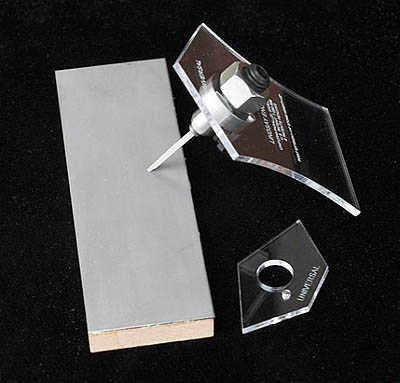
The Lindsay
Graver Sharpener helps grind this point easily...click
|
The Uniform-Parallel
Point™ is
similar to having two flat graver points joined together to form a V.
While engraving, lean it to one side or the other and it will cut wide
like a flat point. This makes the point versatile and allows a person to
vary the width of the cut from thin to thick easily.
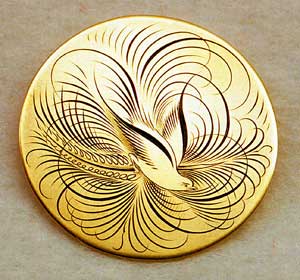
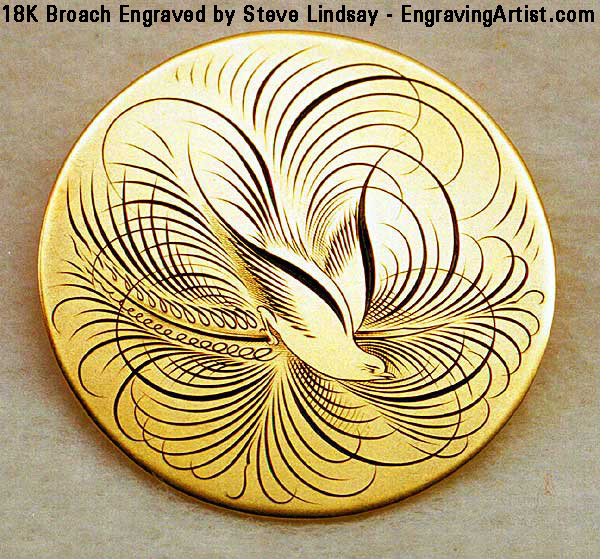
The engraving to the
right would have been difficult if not impossible to execute well without
this point. Being able to vary the width of the cut using one point
to create fine banknote lines and wide lines gives the artist the ability
to express himself easily. |

Click to Enlarge |
Patent License Agreement
The Lindsay Point geometry and
process info is free patent.
After accepting the free license
agreement, use the password you received to continue
to the next page.
An insight on the United
States Patent System
by
Michael Artemis


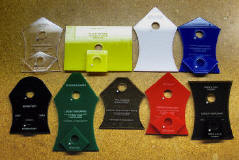
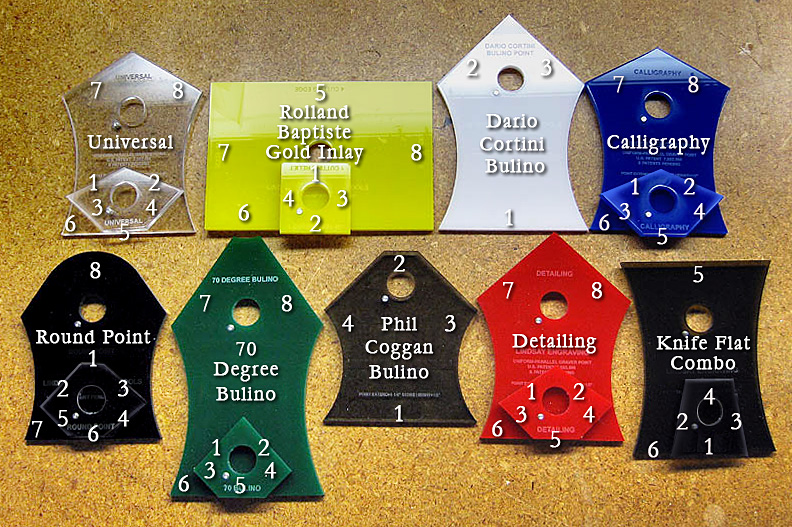
Lindsay Graver Sharpening System uses templates to reproduce various points easily and accurately.
Fixture comes with the Universal (116 degree) template
Click here to view the graver sharpening page
Sharpening Fixture without stones $89
Sharpening Fixture with one stone$128
Sharpening System with fixture and all four diamond bench stones $199
Click
here for INSTRUCTIONS FOR USING SHARPENER