Translate
Arabic Japanese
Chinese Korean
French Portuguese
German Russian
Italian Spanish

Engravers Needed

SCHOOLS

EQUIPMENT

 FORUM


Menu

Introduction
Schools
Online Videos
Online Books
Equipment
Tool Evolution
Impact speed
Tool Article
Lindsay Point
Tool settings
Starting a cut
FAQ
AirGraver Care
Practice plates
Tutorial 1
Tutorial 2
Tutorial 3
Carl Bleile Tutorials
Miscellaneous
Drawing
Transferring
Copyright free
Bulino
Bright Cut
Background
PalmControl CO2
Gold Inlay
Gold Wire Making
Burnishes
Undercurrents
Torch & Tank Setup
Beading Tools
Polishing Gravers
EngravingArts

Patented Uniform-Parallel Point™


Click to Enlarge


The two axis to become familiar with for sharpening graver points are
the Loft or "Pitch angle" and the Yaw or "Roll angle"

How do you determine a set of angles for a particular V angle point? Three point grinds with predetermined angles are included later on this page. The following describes how to figure out the relief yaw angle for other V points.

The geometry can conceivably have any width V angle, narrow or wide, as well as any loft primary heel angle or face angle.

To discover a set of angles for a point, follow these steps:

1. Grind the face to a desired angle (for example, 35, 40, 45, 50).
2. Grind the two primary heels at whatever width V angle is desired (primary heel yaw angle, for example 90, 100, 120)
3. Add the two long relieving facets on the bottom, so that all but a narrow portion of the primary heels next to the cutting edge is ground away.

This is it, but the challenging part is determining what the yaw angle should be to relieve the primary heel properly. It will take some trial and error. The lower the loft angle of the relieving facets, the better. Two degrees is a good angle. The yaw angle will be around 14 to 8 degrees wider than the angle of the primary heel V.  

The higher the loft angle used for the primary heel the more clearance it will give.  A lot of engravers prefer 15 degrees loft for the primary heel, but this can be increased to 20 or even 25 if desired.  This angle is what effects the angle of attack a graver needs to be at before the point will begin cutting but in addition, the higher this angle is the more clearance the heel will have to keep from dragging. 

For example, if 120 V is selected for the primary heel, the setting on a sharpener would be 30,30 for the yaw to make 120. So a first try may be to grind 5 degrees less than that per side (25,25). While grinding these, check to see how they are relieving the primary heel. If the heels are not coming out parallel with the cutting edges, adjust the yaw slightly whichever way is needed, and try again. Once the relief facets are relieving the primary heels properly and parallel, it will be the ideal set-up. Write these numbers down!

After a set of numbers for a particular point has been determined, for future gravers with the same point, grind the relief angles first and then the primary heel. The example above is done in reverse order only to determine the yaw angles of the relieving facets. Once this is known, grind the relief facets before the primary heels.

For the life of the completed graver, it will not be necessary to regrind the long relieving facets during re-sharpening as long as the same face and heel width are used. However, if you change the primary heel V width, the heel loft angle, or the face angle, you will then need to refigure and regrind the two long relieving facets so they are relieving the cutting edge properly. The lower the secondary relief facets loft angles are ground, the better. One to five degrees is good. With primary heel V widths of 110 and under, extra clearance is helpful, and is described later on this page.

Here are three of the points (90, 115 and 120) that have been pre-determined.
These three example grinds are figured using primary heels of 15 degree loft, a 45 degree face and relieving facets of 2 degrees loft. If any of these three angles are changed it will change the illustrated chart. The geometry can conceivably have any width V angle, narrow or wide as well as any loft primary heel angle or face angle.  

Note: the angles on the chart are carried out to a tenth of a degree. Round them off if needed.
Primary heel V Angle (with 15 degrees loft) Yaw angle deducted from primary heel angle (per side)
with 2 degree loft
Do the positive 2 degree relieving facets completely clear? Does the additional clearance option help? (described further down on this page)
90
(45,45)
5.8
(39.2,39.2)
No Almost clears,
Still nice cutting point
115
(32.5,32.5)
5
(27.5,27.5)
Yes Yes, but not required to clear
120
(30,30)
4.8
(25.2,25.2)
Yes Yes, but not required to clear

The patent and patent claims do not specify angles.  This is done to have broad patent protection.  The patent writing concerning this only specifies having the primary heel substantially parallel to the cutting edge. 

Instructions to grind the example points.   
Click images on right to enlarge


1. With a 100 or 260 grit lap, rough-grind the face of the graver at 45 degrees.

2. Next, taper the graver to the amount you would like. (Tapering the graver is described further down on this page.  The illustrations on the right also include tapering)

3. Look at the chart and decide what primary heel V angle graver you'd like to make. For example, select 115 V.

4. Set the loft angle on your sharpener to 2 degrees and, using the chart, look at the second column for the angle of the reliving facets (27.5,27.5).

5. Set the yaw angle on the sharpener to 27.5, and grind the long reliving facets with the 100 or 260 grit lap.

6. Using a 1200 grit lap, regrind the 45 degree face. This is just to put a good final finish on the face.

7. The next step is to place the two small primary heels. Look at the first column on the chart at 115 V point. Under it in parentheses is (32.5,32.5).

8. Set the sharpener at 32.5 yaw, and at 15 degrees loft. If you have a power hone, for this operation do not turn it on.

9. With the graver set at these angles, set the graver tip on the 1200 grit lap and move it back and forth by hand approximately one-half inch. Move it side-to-side this way, from one to ten times depending on the size of heel desired.

10. After grinding one heel, turn the fixture past 0 and to 32.5 for the other heel. If the heels do not come out parallel with the cutting edges, your sharpener may be a little off. If this is the case, try to determine from the grind results which way you need to adjust the relief grind yaw angle so the heels come out parallel. If the loft angle is off on the sharpener, this can throw the results off, too.

The graver is now ready for use. When the point needs to be re-sharpened during use, touch up only the face and primary heels with the 1200 lap. The primary heels and face can be polished if desired, but unless you are doing bright cut engraving, polishing isn't necessary.

After a graver is completed, it will not be necessary to regrind the long relieving facets during use. However, if you change the primary heel V width, the heel loft angle, or the face angle, remember that you will need to refigure and regrind the two long relieving facets so they are relieving the cutting edge properly. The lower the secondary relief facets loft angle are ground, the better. One to five degrees is good. The illustrated chart is based on 2 degrees.
 

Click images to enlarge


Slightly Incorrect Ground Relief

This image is from a similar drawing in the patent and illustrates a slightly incorrect ground point. The point has some benefit of the relieving facets but if the secondary relief facets are ground so that they relieve the primary heels more evenly with the cutting edge, the point will cut with less drag.   Click to Enlarge


Achieving additional
clearance

Additional clearance option: Using the same angle as was used to grind the relief facets (2 degrees if using the chart), carefully grind a third, very small relief facet. This third facet should be placed on the bottom (as if you were making a flat graver). This will cut away a portion of the heel behind the point and leave only the smallest amount of the heel behind the point still intact. Be careful not to grind this too far or you will have a flat tipped point rather than a sharp V point and the graver will tend to dive. The smallest amount of the heel (no less than .002") also needs to be left intact or the graver will tend to dive when starting a cut. To help with size comparison, the thickness of a sheet of paper is around .004". When re-sharpening the point just re-grind the face and heels. The small relief facet won't need to be reground.

With primary heel V widths of under 110, this extra clearance is helpful.

Click to Enlarge 


Negative ground secondary relief facets

Use of a negative angle when grinding the relief facets will provide more clearance. Instead of a positive 1 or 5 degrees use a negative angle, up to negative 10 degrees. Negative ground relief facets will appear as notched facets and will taper the graver shank behind the point in the opposite direction as positive loft secondary relief facets.

Click image to enlarge 

How large of primary heel? 
The size of the primary heel is important. If it is made too long, it will still drag when cutting around a sharper corner. This can be cut away if desired by using the additional clearance described above. The heel of the pre-sharpened gravers that are sent with the AirGravers have been made a little longer than necessary, and may still drag around a sharp corner during fine engraving. The heel is made longer to help beginners, who are more likely to break the point. If the point does break, the longer heel makes it easier to re-sharpen, since only regrinding the face will be necessary. The face angles were ground at 45 degrees. Depending on the size of the break of the tip, the graver with the longer heel can be re-sharpened several times by just re-grinding the face, and not having to re-grind the primary heels. An optimum heel width behind the cutting edge and point, however, is .002" to .015".

The geometry can be used for fine shading work, deep bright-cut, or deep outline engraving, all without changing the primary heel size. The point is versatile, and doesn't require a different graver or heel length for going from shallow to deep engraving. To some degree, the length of the heel can be a factor if going from delicate to deep engraving, but that heel length difference is minimal, ranging from .002" to .015" or .020".

There is an alternative. A .020” heel can still be used for very delicate, sharp corners or arcs by using the additional clearance option described above. A .003" or shorter heel length is good for extra-fine sharp turns and arcs, or use the additional clearance option described on this page. To help with size comparison, the thickness of a sheet of paper is around .004". The pre-sharpened Carbalt gravers are sent out around .020".

Tapering
Grind the top and sides of the graver shank at around 10 degrees. It is unimportant what angle is used or how the shank is narrowed or tapered. I use three facets on the top for the tapering but it will also work to round the top of the graver or use other facets on top and on the sides.  More information and cautions about tapering.

Click to enlarge

What width of V should be used on the primary heels?
The V width angles I use generally range from 115 to 135. For the banknote style and bright-cut lettering engraving, I favor about a 125. If a person does a lot of bright-cut engraving, a polished 130 or even 135 can be easier to use than a polished flat graver. For those that have been engraving with a 90 degree point, a narrower 100 to 110 might be easier to begin with, then working up to the 120 - 125 range. If a person is just starting out, it is probably best to begin right away around 110 - 120. The engraver won't have to learn twice, and it will also help to prevent developing a “heavy hand”. Coming from a narrow graver to a wider graver tends to give a person a heavy hand, and it is hard for the person to hold back from engraving too deeply when switching to a wider point. In the end, however, I find that a wider point is easier to control for both shade lines and outlines.

The patented geometry can conceivably have any width V angle (narrow or wide), as well as any loft primary heel angle or face angle. With this said, there is nothing wrong with a narrower point being used with the secondary relieving facets. A narrower graver, such as a 90 degree point, is more forgiving and will keep from cutting too wide with a heavy hand. If you do use a 90 degree point, try it with the relieving facets along with the additional clearance option described above.

Polishing
The primary heels and face can be polished if desired, but unless you're doing bright cut engraving it this isn't necessary.  Apply 60,000 mesh diamond compound to a ceramic, steel, copper, or brass lap, and use it for polishing the face and the two primary heel facets.

When a metal lap is used, some of the diamond will embed itself into the metal, preventing it from wiping off.  This is called “charging” a lap.  NOTE: When polishing, do not lean or push on the graver point while it is being polished. Let the graver ride softly on the lap, and allow the diamond to work. If the engraver pushes while using a metal polishing lap, the graver will chew the metal lap up.  Hold the graver on the lap softly.  The back side of a metal diamond lap can work for a polishing lap.

Point strength and points breaking
The blunter angle a point is, the stronger it will be. Here are methods to increase strength for when points start breaking.

1: Dubbing the point. After the point is sharpened hold it up on a stone or lap at a steeper angle than the face was ground and grind a very small 2nd face. For example if the face angle on the graver is at 45 degrees then maybe use 60 degrees. Set it on the lap or stone and very lightly move it a short distance by hand. This will place a 60 degree face at the very tip. If engraving a hard metal and the point is still breaking, this angle can be raised all the way to 90 degrees (the graver will be vertical). If it is still breaking try a little larger 90 face or go to a wider V point.

2: The wider a primary V heel used, the stronger the point will be. If you want to use a narrow graver in hard metal about all you can do is use High Speed Steel or Cobalt and dub the point. A narrow V is just too fragile when made from Carbalt or Carbide. If you can use a wide point instead of narrow, do so with Carbalt and dub it slightly. This is about as tough of point as possible.

Click Image to Enlarge


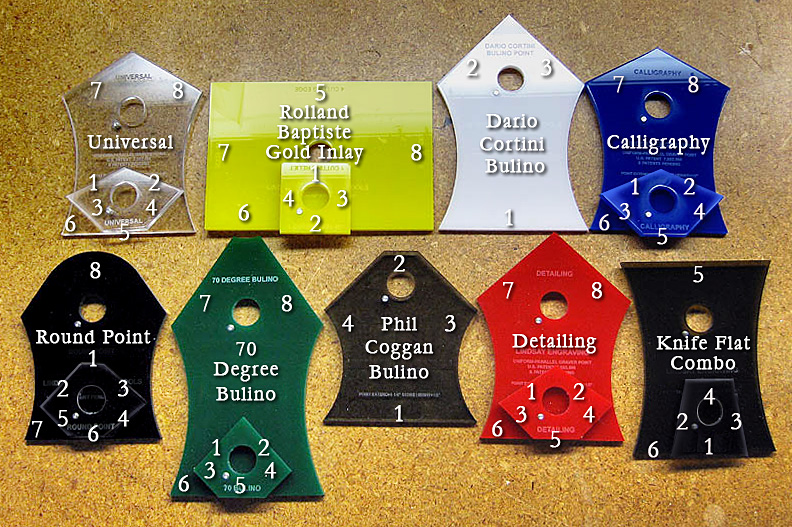
Lindsay Graver Sharpening System uses templates to reproduce various points easily and accurately.
Fixture comes with the Universal (116 degree) template Click here to view the graver sharpening page


Click here for INSTRUCTIONS FOR USING SHARPENER


 HandEngravingArtist.com
HandEngraveTools.com
 HandEngravingClasses.com
HandEngravingForum.com
HandEngravingSchool.com